

Why the Five-Year Medicaid Lookback Period Isn’t Always the Disaster Families Fear
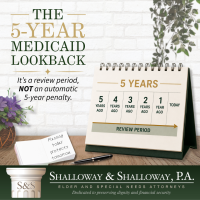
When a Florida family begins planning for long-term care, one phrase can cause immediate panic: “the five-year lookback.”
Families often hear that Medicaid will examine everything they have done with their money during the previous five years and assume that one mistake—or one gift to a child—will automatically result in five years without Medicaid.
That is not how the rule works.
The five-year lookback is important, and transfers of assets absolutely need to be taken seriously. But the lookback period is not itself a five-year penalty period. It is a period during which Medicaid reviews financial transactions to determine whether the applicant made certain uncompensated transfers that could result in a period of ineligibility.
Understanding that distinction can completely change the way a family approaches Medicaid planning.
For Florida families facing nursing-home care, assisted living, or other long-term-care needs, the five-year lookback is often a problem that can be analyzed, managed, and sometimes resolved—not a reason to assume that Medicaid is no longer an option.
What exactly is the five-year lookback?
Florida Medicaid’s long-term-care eligibility rules are governed by federal Medicaid law and implemented in Florida through statutes and administrative rules. Florida Statutes section 409.919 authorizes the state to adopt rules necessary to administer Medicaid and comply with federal requirements.
One of the principal Florida rules governing transfers is Florida Administrative Code Rule 65A-1.712, SSI-Related Medicaid Resource Eligibility Criteria. The rule implements federal transfer-of-assets requirements and applies to individuals seeking Medicaid long-term-care services, including nursing-facility care and certain home- and community-based waiver services.
The basic concept is this:
When someone applies for Medicaid long-term-care benefits, the state looks back 60 months from the relevant Medicaid application/lookback date and examines certain transfers of assets or income.
But here is the important part:
The state is not asking, “Did you give anything away during the last five years?”
It is asking whether the applicant, spouse, or someone acting on the applicant’s behalf transferred resources or income for less than fair market value in a way that Medicaid rules treat as an uncompensated transfer.
That is a very different question.
The lookback is a review period—not a five-year penalty
This is probably the most important misconception to correct.
A family may say, “Mom gave her daughter $50,000 three years ago, so she’s going to have a five-year Medicaid penalty.”
Not necessarily.
If the transfer is determined to be an uncompensated transfer, Medicaid does not generally impose a five-year period of ineligibility simply because the transfer occurred within the five-year lookback.
Instead, the amount of the uncompensated transfer is used to calculate a penalty period.
The penalty is based on the amount transferred and the applicable Medicaid divisor. In other words, a $20,000 transfer does not automatically produce the same penalty as a $200,000 transfer.
This distinction is critical because it means that the existence of a transfer does not automatically mean that Medicaid planning has failed.
Not every transaction is a “bad transfer”
Another reason families should not panic is that Medicaid does not treat every movement of money as an uncompensated gift.
For example, spending money on the applicant’s own needs is generally not the same thing as giving the money away.
A person may spend down assets on legitimate expenses such as:
- Medical care and medical equipment
- Dental work
- Home repairs
- A vehicle
- Clothing and personal items
- Funeral and burial arrangements
- Necessary household expenses
- Professional fees
- Long-term-care expenses
- Other goods and services purchased for fair market value
The critical issue is generally whether the applicant received fair value in exchange for the asset.
If Mom pays $40,000 for a new roof on her home, she has not necessarily given away $40,000. She has converted cash into an improvement to her property.
Similarly, paying legitimate expenses for the applicant is fundamentally different from simply transferring cash to a family member with no compensation.
Florida’s Rule 65A-1.712 specifically addresses transfers for less than fair market value and requires the state to evaluate transfers under the federal Medicaid transfer rules.
Some transfers are specifically permitted
Even when an asset is transferred without receiving fair market value, Medicaid law contains important exceptions.
For example, federal Medicaid rules generally permit certain transfers to or for the benefit of:
- A spouse;
- A blind or disabled child;
- Certain trusts established for a disabled individual;
- In certain circumstances, a sibling who has an equity interest in the home and who lived there for at least one year before the applicant entered an institution; and
- A child who meets the requirements of the caregiver-child exception.
These exceptions can be extremely important in Florida Medicaid planning.
The caregiver-child exception, for example, can allow a parent to transfer a home to a qualifying adult child who provided care that permitted the parent to remain at home rather than enter a nursing facility. But this is not a casual exception. There are specific requirements, and documentation matters.
The lesson is that a family should not look at a transaction simply as “Mom gave away her house” or “Dad gave money to his daughter.”
The legal question is more complicated:
What was transferred, to whom, for what reason, under what circumstances, and what did Medicaid law say about that particular transaction?
A transfer can sometimes be fixed
Even when Medicaid determines that a transfer was uncompensated, that does not necessarily mean the situation is permanent.
One of the most important planning tools is the return of the transferred asset.
If the transferred asset—or its value—is returned to the Medicaid applicant, the resulting penalty can potentially be eliminated or reduced, depending upon the circumstances and the amount returned.
This is one reason it is so important to analyze a questionable transfer before assuming that Medicaid eligibility has been destroyed.
For example, suppose a parent transferred $60,000 to a child two years ago. The family discovers during Medicaid planning that the transaction could be considered an uncompensated transfer.
That does not necessarily mean the parent must simply accept a lengthy period without Medicaid.
The family and counsel may explore whether the funds can be returned, whether the transaction actually constituted a transfer for less than fair market value, whether an exception applies, or whether another legal strategy is available.
The sooner the problem is identified, the more options the family may have.
The passage of time matters
The five-year lookback can actually work in a family’s favor.
A transaction that is more than 60 months old generally falls outside the lookback period for a new Medicaid application.
That means the lookback is not an endless examination of everything someone has done financially during their adult life.
If a parent made a gift seven years ago, for example, that transaction generally is not within the five-year review period for a current Medicaid application.
This is one reason advance planning can be so valuable.
Families sometimes think, “It’s too late because Mom is already in the nursing home.”
But even then, the analysis should begin with the actual dates and transactions.
A transaction that occurred four years and ten months ago is very different from one that occurred five years and two months ago.
Dates matter. Documentation matters. The nature of the transaction matters.
What if Mom gave money to her children?
This is one of the most common situations that creates anxiety.
Perhaps Mom gave each of her three children $10,000 for a down payment on a house. Or she helped a child pay college expenses. Or she transferred money to a child because the child had financial problems.
If those transfers occurred within the lookback period, they need to be disclosed and analyzed.
But again, the existence of a gift does not mean that Mom is automatically disqualified from Medicaid for five years.
The attorney should determine:
- When was the transfer made?
- How much was transferred?
- Was anything received in return?
- Was the transfer actually a gift?
- Was there a written agreement?
- Does a Medicaid exception apply?
- Can the transfer be returned?
- Is there another explanation for the transaction?
- Does the transaction actually create a penalty?
- If there is a penalty, how long would it last?
That analysis can produce a very different result from simply assuming the worst.
Undue hardship is another important protection
Florida’s Medicaid rules also recognize an undue-hardship exception.
Under Rule 65A-1.712, a transfer penalty is not imposed if denying eligibility because of the transfer would cause an undue hardship meeting the rule’s requirements. The rule describes undue hardship in terms of deprivation of food, clothing, shelter, or medical care such that the individual’s life or health would be endangered. It also requires efforts to access the transferred resources to be exhausted before the exception applies.
This is not an automatic escape hatch. It is a serious exception with specific requirements and should not be treated as the family’s primary planning strategy.
But its existence is another reason that the five-year lookback should not be viewed as an automatic five-year denial of Medicaid.
Florida’s Long-Term Care Partnership Program can make an enormous difference
Florida also has another important planning tool that many families overlook: the Long-Term Care Insurance Partnership Program.
Florida Statute § 409.9102 directs the state to establish a qualified long-term-care insurance partnership program. The statute specifically provides a mechanism for individuals with qualifying partnership policies to receive a Medicaid asset disregard equal to certain long-term-care insurance benefits paid on their behalf.
That means qualifying long-term-care insurance can potentially protect assets even when someone eventually needs Medicaid.
For example, if a qualifying Partnership policy pays $200,000 in long-term-care benefits, Florida Medicaid can disregard an equivalent amount of assets when determining eligibility, subject to the applicable rules.
This is a good illustration of why Medicaid planning is not simply about “giving everything away five years before you need care.”
There are legal ways to coordinate private resources and Medicaid.
The biggest mistake is waiting until the Medicaid application
The five-year lookback is most frightening when the family first thinks about it after a parent has entered a nursing home.
At that point, there may be very little time to make thoughtful decisions.
But even then, families should not assume the situation is hopeless.
The right approach is to reconstruct the financial history and analyze it transaction by transaction.
Gather five years of:
- Bank statements
- Brokerage statements
- Tax returns
- Real-estate records
- Deeds
- Checks and cancelled checks
- Gift records
- Trust documents
- Annuity contracts
- Vehicle titles
- Loan documents
- Personal-services agreements
- Other significant financial records
Then have the transactions reviewed under Florida’s Medicaid rules.
Florida Statute § 409.904 recognizes Medicaid coverage for certain individuals who need nursing-facility, hospice, or home- and community-based services and establishes that eligibility is subject to income and asset requirements under federal and state law.
The state is also specifically authorized to administer Medicaid eligibility rules through Florida Statute § 409.919.
The five-year lookback is a tool, not a verdict
The phrase “five-year lookback” sounds ominous because families naturally hear the words as “five years of punishment.”
But that is not what the rule says.
The lookback is a window for reviewing transactions.
A transfer within that window may or may not be a problem. If it is an uncompensated transfer, it may or may not qualify for an exception. If a penalty applies, the penalty is based on the amount of the uncompensated transfer—not simply on the fact that the transaction occurred during the five-year period. And in some circumstances, the transfer can be returned or other remedies may be available.
For Florida families, the most important lesson is simple:
Do not let the five-year lookback scare you into believing that Medicaid is off the table.
Instead, identify the transactions, understand the rules, calculate the potential exposure, and look for legitimate solutions.
Medicaid planning is not about hiding assets or pretending a transfer never happened. In fact, Florida’s Medicaid application process requires applicants to provide information and documentation concerning their resources and financial circumstances. The state’s transfer rules are designed to determine whether assets were transferred for less than fair market value and, if so, whether a penalty should apply.
The goal is to work within those rules.
And in many cases, once the five-year lookback is examined carefully rather than feared generally, families discover something important:
The lookback may be an obstacle—but it is not necessarily a disaster.
A Florida Elder Law Attorney Can Help
If you or a loved one is facing a Medicaid application and you’re concerned about financial transactions made during the five-year lookback period, don’t assume Medicaid eligibility is out of reach. An experienced Florida elder law attorney can review the circumstances, identify potential issues, and help you understand what options may be available.
Contact Shalloway & Shalloway to discuss your family’s Medicaid planning needs.
This article is intended for general educational purposes and is not legal advice. Medicaid eligibility rules are highly fact-specific, and Florida and federal rules can change. Families dealing with a current or anticipated Medicaid application should have their individual circumstances reviewed by a Florida elder-law or Medicaid-planning attorney before making transfers or other significant financial changes.