

ABLE Accounts in 2026: Expanded Eligibility Creates New Planning Opportunities for Medicaid, SSI, and Special Needs Beneficiaries
For Florida families navigating disability planning, Medicaid eligibility, SSI preservation, and special needs trust planning, the expansion of ABLE account eligibility creates important new opportunities.
A Landmark Change in Florida Disability Planning
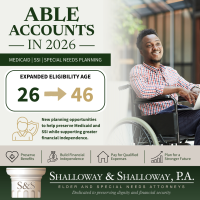
Beginning January 1, 2026, one of the most important disability planning reforms in recent memory took effect. The ABLE Age Adjustment Act expanded eligibility for Achieving a Better Life Experience (ABLE) accounts by increasing the disability onset age requirement from age 26 to age 46.
While the change may appear modest on its face, its practical impact is enormous. Millions of Americans who previously did not qualify for ABLE accounts may now be eligible to utilize one of the most flexible and tax-efficient planning tools available to individuals with disabilities.
For elder law attorneys, estate planning attorneys, financial advisors, accountants, trustees, care managers, settlement planners, and families, this expansion creates significant new opportunities to preserve public benefits while improving financial independence and quality of life.
The result is that ABLE accounts are no longer a niche planning strategy. They are rapidly becoming an essential component of comprehensive disability planning.
What are ABLE Accounts?
ABLE accounts were established under Section 529A of the Internal Revenue Code and are modeled after traditional 529 college savings plans.
The purpose of an ABLE account is to allow eligible individuals with disabilities to save and invest money without jeopardizing eligibility for certain means-tested government benefits.
The advantages are substantial:
- Tax-deferred investment growth
- Tax-free distributions for qualified disability expenses
- Preservation of Medicaid eligibility
- Favorable SSI treatment
- Simplified administration
- Greater financial independence
- Lower administrative costs than many trust arrangements
Historically, many individuals receiving public benefits were effectively discouraged from saving because accumulating assets could result in the loss of critical government assistance. ABLE accounts help solve that problem.
The ABLE Age Adjustment Act: Why It Matters
Prior to 2026, an individual generally had to establish that the onset of disability occurred before age 26.
This restriction excluded countless Americans who became disabled later in life.
Beginning January 1, 2026, the disability onset requirement increased to age 46.
The change dramatically expands eligibility to include many individuals who become disabled due to:
- Stroke
- Traumatic brain injury
- Multiple sclerosis
- Parkinson’s disease
- Mental health disorders
- Neurological diseases
- Service-connected disabilities
- Cancer-related impairments
- Autoimmune conditions
- Serious accidents
For elder law practitioners helping Florida families, this is particularly significant because many clients become disabled during adulthood rather than childhood.
Consider these examples:
Example 1: Stroke Survivor
A successful executive suffers a disabling stroke at age 42. Prior to 2026, he generally would not have qualified for an ABLE account. Today, he may qualify and gain access to a powerful savings and benefits-preservation tool.
Example 2: Multiple Sclerosis Diagnosis
A woman diagnosed with multiple sclerosis at age 38 may now establish an ABLE account to help preserve Medicaid and SSI eligibility while maintaining financial flexibility.
Example 3: Veteran with Service-Connected Disabilities
A veteran who develops disabling conditions in his thirties may now qualify for ABLE planning opportunities that previously were unavailable.
These examples illustrate why the age expansion is considered one of the most meaningful disability-planning developments in years.
Qualified Disability Expenses: More Flexible Than Most People Realize
One of the greatest strengths of ABLE accounts is the broad definition of “qualified disability expenses.”
Unlike many planning vehicles that impose restrictive spending rules, ABLE accounts allow funds to be used for a wide range of expenditures that improve health, independence, and quality of life.
Qualified disability expenses may include:
Housing
- Rent
- Mortgage payments
- Property taxes
- Utilities
- Home modifications
Transportation
- Vehicle purchases
- Vehicle maintenance
- Public transportation
- Ride-sharing services
Healthcare
- Medical treatment
- Health insurance premiums
- Prescription medications
- Assistive devices
- Therapy
Education
- Tuition
- Books
- Vocational training
- Continuing education
Employment Support
- Job coaching
- Career training
- Workplace accommodations
Professional Services
- Legal fees
- Financial management fees
- Accounting services
The breadth of permitted expenditures often makes ABLE accounts more practical for daily use than special needs trusts.
Understanding Contribution Limits
ABLE accounts are subject to annual contribution limits.
Contributions may come from:
- Parents
- Grandparents
- Siblings
- Friends
- Trusts
- Estates
- The beneficiary
The annual contribution limit is adjusted periodically and is tied to federal gift tax exclusion amounts.
Although contribution limits remain important, the practical reality is that many beneficiaries can accumulate substantial savings over time through regular contributions and investment growth.
The Often Overlooked ABLE to Work Program
One of the most underutilized features of ABLE planning is the ABLE to Work program.
Eligible employed beneficiaries may contribute amounts above the standard annual contribution limit based upon earned income and federal guidelines.
This provision serves an important public policy goal.
Historically, individuals with disabilities often faced a difficult dilemma:
- Work and accumulate savings, risking benefit eligibility; or
- Preserve benefits by limiting financial growth.
ABLE to Work helps reduce this conflict by encouraging employment while allowing beneficiaries to build financial security.
For financial advisors and accountants working with disabled clients, this provision deserves special attention.
ABLE Accounts and Supplemental Security Income (SSI)
The interaction between ABLE accounts and SSI is one of their most valuable features.
Ordinarily, SSI recipients are subject to strict resource limitations.
Exceeding those limits can result in suspension or loss of benefits.
ABLE accounts provide a significant exception.
Generally, the first $100,000 in an ABLE account is excluded from SSI resource calculations.
This allows beneficiaries to save meaningful amounts without immediately jeopardizing eligibility.
For many Florida families, this represents a transformational planning opportunity.
Instead of remaining perpetually asset-poor, beneficiaries can:
- Build emergency reserves
- Save for housing
- Purchase transportation
- Prepare for future medical needs
- Improve financial stability
Medicaid Planning Benefits
ABLE accounts also play an important role in Medicaid planning.
For many disabled individuals, Medicaid provides essential services including:
- Medical care
- Prescription coverage
- Long-term services and supports
- Home and community-based services
- Waiver benefits
- Attendant care
Losing Medicaid eligibility can be devastating.
ABLE accounts help preserve eligibility while simultaneously improving financial flexibility.
This combination makes ABLE planning particularly attractive for elder law attorneys and disability planning professionals.
Florida-Specific Considerations
Florida families should evaluate ABLE accounts within the broader context of:
- Medicaid planning
- SSI eligibility
- Special needs trusts
- Guardianship avoidance
- Powers of attorney
- Long-term care planning
A coordinated approach often produces substantially better outcomes than relying on any single planning technique.
As with most elder law matters, customization is critical.
ABLE Accounts Versus Special Needs Trusts
Perhaps the most common misconception is that ABLE accounts eliminate the need for special needs trusts.
They do not.
Instead, the two tools frequently work best together.
Advantages of Special Needs Trusts
Special needs trusts generally offer:
- No annual contribution limits
- Ability to receive large inheritances
- Ability to receive personal injury settlements
- Enhanced asset protection
- Professional trustee oversight
- Sophisticated planning flexibility
Advantages of ABLE Accounts
ABLE accounts generally offer:
- Lower administrative costs
- Simpler administration
- Direct beneficiary access
- Tax-free qualified distributions
- Easier payment of housing expenses
- Greater beneficiary independence
In many cases, a special needs trust functions as the primary asset repository while the ABLE account serves as a practical spending and management account.
First-Party and Third-Party Special Needs Trust Coordination
ABLE accounts become even more powerful when coordinated with special needs trusts.
First-Party Special Needs Trusts
These trusts typically contain the disabled individual’s own assets, including:
- Personal injury settlements
- Inheritances received outright
- Savings accumulated prior to disability planning
Third-Party Special Needs Trusts
These trusts generally contain assets belonging to parents, grandparents, or other family members.
Both trust types can often work alongside ABLE accounts to maximize flexibility while preserving public benefits.
For many Florida families, the combination provides the best overall outcome.
Personal Injury and Settlement Planning Opportunities
Personal injury attorneys and settlement planners should pay close attention to the ABLE expansion.
Individuals receiving:
- Personal injury settlements
- Medical malpractice recoveries
- Workers’ compensation benefits
- Structured settlement payments
may benefit significantly from integrating ABLE accounts into broader settlement planning strategies.
While larger settlements often require special needs trusts, ABLE accounts frequently provide a useful companion strategy.
Medicaid Estate Recovery Considerations
Although ABLE accounts offer significant advantages, professionals should not overlook potential Medicaid estate recovery considerations.
Recovery rights vary depending upon applicable law and individual circumstances.
Florida families should evaluate these issues carefully when designing a comprehensive disability-planning strategy.
Common Planning Mistakes
Professionals should avoid several common errors:
- Assuming all disabled individuals qualify
- Ignoring disability onset requirements
- Failing to coordinate ABLE accounts with trusts
- Overlooking SSI implications
- Neglecting Medicaid recovery considerations
- Poor recordkeeping regarding qualified expenses
Proper planning remains essential.
Looking Ahead
The 2026 expansion of ABLE account eligibility represents one of the most significant disability-planning developments in years.
By increasing the disability onset age from 26 to 46, Congress expanded access to a powerful planning tool that combines tax advantages, public-benefits preservation, and financial independence.
For elder law attorneys, estate planners, financial advisors, accountants, trustees, fiduciaries, care managers, and families, ABLE accounts deserve renewed attention.
When properly coordinated with Medicaid planning, SSI preservation strategies, and special needs trusts, ABLE accounts can help individuals with disabilities achieve greater financial security while maintaining access to critical public benefits.
Need Help Determining Whether an ABLE Account Fits Your Plan?
The expansion of ABLE account eligibility creates important new opportunities for many Florida families. However, ABLE accounts are only one piece of a comprehensive disability planning strategy.
Depending on your circumstances, it may also be important to consider Medicaid planning, SSI preservation, special needs trusts, powers of attorney, guardianship alternatives, and long-term care planning.
The attorneys at Shalloway & Shalloway help families throughout Florida evaluate their options and develop personalized strategies designed to protect assets, preserve benefits, and enhance quality of life.
Learn more about our Special Needs Planning and Elder Law services or contact our office to schedule a consultation.
Frequently Asked Questions
What is an ABLE account?
A tax-advantaged savings account designed for eligible individuals with disabilities.
Who qualifies in 2026?
Generally, individuals whose disability onset occurred before age 46 and who meet applicable disability requirements.
Does an ABLE account affect Medicaid eligibility?
Properly structured ABLE accounts generally preserve Medicaid eligibility.
Can an ABLE account replace a special needs trust?
Usually not. In many situations the two tools work best together.
Can someone over age 40 qualify?
Yes, provided the disability onset occurred before age 46.
Are ABLE accounts only for children?
No. The 2026 expansion dramatically increases access for adults with disabilities.