Assisted Living vs. Nursing Homes: Florida Medicaid Planning Explained

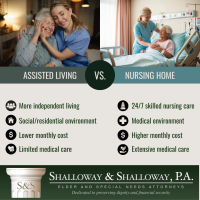
As Florida’s population continues to age, more Florida families are facing difficult decisions about long-term care for aging parents, spouses, or even themselves. One of the most common areas of confusion involves the difference between assisted living facilities and nursing homes — and perhaps even more importantly, how these types of care can be paid for without exhausting a lifetime of savings.
Families are often shocked to discover that long-term care costs can easily range from $5,000 to well over $15,000 per month depending on the level of care needed and the geographic area involved. Many people incorrectly assume that Medicare will cover these costs indefinitely. In reality, Medicare coverage for long-term custodial care is extremely limited.
Fortunately, with proper Florida Medicaid planning and asset protection strategies, many families can legally preserve significant assets while still qualifying for benefits that help pay for care.
Understanding the Difference Between Assisted Living and Nursing Homes
Although people frequently use the terms interchangeably, assisted living facilities (“ALFs”) and nursing homes provide very different levels of care.
Assisted Living Facilities (ALFs)
An assisted living facility is designed for individuals who still maintain some degree of independence but need help with activities of daily living. These activities may include:
- medication management
- meal preparation
- bathing assistance
- dressing assistance
- transportation
- supervision and reminders
- limited memory care services.
Residents of assisted living facilities generally live in private or semi-private apartments and often enjoy a more residential and social environment.
Many assisted living residents are still capable of walking independently, participating in activities, and making many decisions on their own. The facility primarily provides supportive care rather than intensive medical treatment.
In Florida, some assisted living facilities also offer specialized memory care units for individuals with Alzheimer’s disease or dementia.
Nursing Homes
Nursing homes, by contrast, provide a significantly higher level of medical care. These facilities are designed for:
- individuals who require 24-hour skilled nursing supervision
- extensive assistance with mobility
- feeding assistance
- wound care
- rehabilitation services
- ongoing medical monitoring
- complex medication administration
Many nursing home residents are bedridden, require two-person transfers, suffer from advanced dementia, or have serious chronic medical conditions.
Unlike assisted living facilities, nursing homes are heavily medicalized environments with nurses on duty around the clock.
Assisted Living vs. Nursing Home Quick Comparison
| Assisted Living | Nursing Home |
|---|---|
| More independent living | 24/7 skilled nursing care |
| Social/residential environment | Medical environment |
| Lower monthly cost | Higher monthly cost |
| Limited medical care | Extensive medical care |
Cost Differences Between ALFs and Nursing Homes
One major distinction between the two types of care is cost.
Assisted Living Costs
In Florida, assisted living facilities commonly range from approximately $4,000 to $8,000 per month, although luxury facilities or memory care units may cost substantially more.
Importantly, assisted living bills are often divided into room and board and care services. This distinction becomes important for Florida Medicaid planning purposes.
Nursing Home Costs
Florida nursing homes frequently cost between $11,000 and $16,000 per month or more depending on the facility and level of care.
Unlike assisted living facilities, nursing homes generally bundle housing and medical care together into one comprehensive monthly charge.
Without advance planning, these costs can rapidly consume retirement savings, brokerage accounts, CDs, and even real estate equity.
Medicare vs. Medicaid — A Critical Distinction
Families throughout Florida often confuse Medicare and Medicaid.
Medicare is health insurance primarily for individuals age 65 and older and generally does not pay for long-term custodial care.
Medicare may pay for:
- hospital stays
- doctors
- rehabilitation
- short-term skilled nursing rehabilitation after hospitalization
However, Medicare typically stops paying once rehabilitation goals are met.
Many Florida families are devastated when they learn that Medicare will not continue paying for long-term nursing home residency.
Medicaid, on the other hand, is the primary government program that pays for long-term custodial care in the United States.
Medicaid can help pay for:
- nursing home care
- certain assisted living care programs
- home and community-based services,
- PACE programs (in some situations)
However, Florida Medicaid has strict financial eligibility rules involving both income and assets.
Florida Medicaid Eligibility and Asset Limits
Many people mistakenly believe they must become completely impoverished before qualifying for Medicaid. That is often not true.
With proper legal planning, substantial assets can sometimes be preserved legally and ethically.
Generally speaking, Medicaid examines:
- bank accounts
- investments
- CDs
- non-exempt real estate
- cash value life insurance
- certain retirement accounts
- other liquid assets
For a single individual applying for Florida long-term care Medicaid, countable assets are generally limited to approximately $2,000 unless planning techniques are implemented.
Certain assets may remain protected or exempt, including:
- a primary residence under certain circumstances
- one automobile
- personal belongings
- certain burial arrangements
- some retirement assets depending on payout status and structure
This is where experienced elder law counsel becomes extremely important because exemptions are highly technical and fact-specific.
Florida Medicaid Asset Protection Strategies
One of the largest misconceptions in Medicaid planning is the belief that families must “spend everything down” to a nursing home before seeking legal advice.
In reality, proactive planning may preserve substantial assets.
Certain irrevocable trusts may help protect assets if planning is performed sufficiently in advance of needing care.
Medicaid currently imposes a five-year lookback period on many transfers. Transfers made within five years of applying for nursing home Medicaid may trigger penalties.
However, planning completed early enough may:
- preserve homes
- investment assets
- family wealth
- inheritance goals
When one spouse requires nursing home care but the other spouse remains healthy at home, Florida Medicaid rules may allow the healthy spouse to retain substantial assets and income.
Many married couples are relieved to discover that the healthy spouse does not necessarily have to become financially devastated.
In some married-couple cases, sophisticated Florida Medicaid planning strategies may involve the use of properly structured Medicaid-compliant loans. Under certain circumstances, countable assets may potentially be converted into an income stream payable to the healthy spouse.
In simplified terms, assets that might otherwise cause the couple to exceed Medicaid asset limitations may, if structured correctly, be transformed from a countable resource into income for the benefit of the healthy spouse while helping the institutionalized spouse qualify for Medicaid benefits.
However, families throughout Florida should understand that not all loans or promissory notes are Medicaid compliant. Improper structuring can create:
- substantial Medicaid penalties
- transfer penalties
- tax complications
- disqualification issues
Additionally, the loan strategy itself is only one component of a much larger Medicaid analysis involving:
- income rules
- spousal protections
- timing issues
- powers of attorney
- tax considerations
- estate recovery concerns
- other complex legal issues
For this reason, Florida families should avoid attempting “do-it-yourself” Medicaid loan planning and instead consult with a qualified Florida elder law attorney experienced in Medicaid asset protection planning.
Florida is an “income cap” state for Medicaid.
If an applicant’s gross monthly income exceeds the Medicaid income cap, they may still qualify through the use of a Qualified Income Trust, commonly called a “Miller Trust” or QIT.
A properly drafted QIT can often solve what initially appears to be a disqualifying income problem.
Additional Asset Protection Techniques
Medicaid-compliant loans represent only one of many sophisticated elder law planning strategies that may be available depending upon a family’s financial and medical circumstances.
Every family’s situation is different, and many Florida Medicaid asset protection techniques involve highly technical legal and financial considerations that go well beyond the scope of this article.
For this reason, individuals and families should strongly consider consulting with a qualified Florida Bar Board Certified Elder Law Attorney before implementing any Florida Medicaid planning strategy.
Board certification reflects substantial:
- experience
- peer review
- continuing education
- demonstrated expertise in the specialized area of elder law and Medicaid planning
Florida Medicaid and Assisted Living Facilities
Many families are surprised to learn that Medicaid coverage for assisted living facilities differs significantly from nursing home Medicaid.
In Florida, Medicaid may help cover certain care-related services in qualifying assisted living facilities through waiver programs or managed care programs.
However, Medicaid usually does not fully cover room and board in assisted living, availability of Medicaid beds can be limited, waiting lists may exist, and not all facilities accept Medicaid.
As a result, many families combine private funds, VA benefits, Medicaid waiver assistance, long-term care insurance, and family support to make assisted living financially workable.
Why Timing Matters in Florida Medicaid Planning
One of the most important concepts in Medicaid planning is timing.
Families often wait too long before seeking advice. By the time a loved one is already in a nursing home paying privately at $15,000 per month, many planning opportunities may already have been lost.
Early planning frequently provides more options, greater asset protection, reduced stress, better facility choices, and stronger family coordination.
Even in crisis situations, however, significant planning opportunities may still exist.
Every Family’s Situation Is Different
Florida Medicaid planning is highly individualized.
What works for one family may not work for another.
In addition, Medicaid laws and regulations change frequently, making current legal guidance essential.
Final Thoughts
The transition into assisted living or nursing home care is often emotionally overwhelming for families. In addition to medical and caregiving concerns, families must navigate an incredibly complex financial and legal system.
Understanding the distinction between assisted living facilities and nursing homes is an important first step. Equally important is understanding that Florida Medicaid planning and asset protection strategies may allow families to obtain needed care without unnecessarily losing everything they worked a lifetime to build.
With proper legal planning, families may be able to preserve certain assets legally and ethically while still qualifying for benefits and while maintaining dignity and financial stability.
If your family is facing long-term care decisions, consulting with an experienced Florida elder law and Medicaid planning attorney early in the process can make a tremendous difference in both available options and financial outcomes.
About Shalloway & Shalloway, P.A.
Shalloway & Shalloway, P.A. focuses on:
- elder law
- Medicaid planning
- asset protection
- special needs planning
- probate
- guardianship
- long-term care planning
throughout Florida.
Our firm, located in West Palm Beach, assists families throughout Florida in navigating complex Medicaid eligibility rules while exploring lawful strategies designed to help preserve assets, protect spouses, and obtain quality long-term care benefits.
Attorney Mark Shalloway is a Florida Bar Board Certified Elder Law Attorney with decades of experience in elder law and long-term care planning matters.
The firm offers consultations designed to educate families regarding available options and planning opportunities in a clear, compassionate, and practical manner.
For additional information, visit www.shalloway.com or contact the office to schedule a consultation.
Frequently Asked Questions
Does Medicare pay for nursing home care in Florida?
Medicare generally does not pay for long-term custodial nursing home care. However, Medicare may cover short-term rehabilitation or skilled nursing services following a qualifying hospital stay.
Can Medicaid help pay for assisted living in Florida?
Medicaid may help cover certain care-related services in qualifying assisted living facilities through waiver programs or managed care programs. However, it does not fully cover room and board in assisted living.
What is the Medicaid five-year lookback period?
The Medicaid Lookback Rule is a federal regulation designed to prevent individuals from purporting to give away their assets in order to qualify for Medicaid under the program’s strict asset and income limits.
Can I keep my home if I qualify for Medicaid in Florida?
In many situations, Florida Medicaid applicants may be able to keep their primary residence while still qualifying for certain long-term care Medicaid benefits. However, Medicaid eligibility rules involving homestead property, equity limits, estate recovery, and transfers can be highly technical. Families should consult with an experienced Florida elder law attorney before making decisions involving a home or other real estate assets.
How much money can you have and still qualify for Medicaid in Florida?
Florida Medicaid has strict financial eligibility rules involving both income and countable assets. For a single applicant seeking long-term care Medicaid benefits, countable assets are generally limited to approximately $2,000 unless proper Medicaid planning strategies are implemented. Certain assets may remain exempt or protected depending on the applicant’s circumstances.
When should I start Florida Medicaid planning?
In general, earlier Medicaid planning often provides more legal and financial options. Because Medicaid imposes a five-year lookback period on many asset transfers, proactive planning completed before a medical crisis occurs may help families preserve assets and reduce financial stress. However, even in crisis situations, important planning opportunities may still exist.

